“Mors lilla Olle”
Handling the Undead“Mors lilla Olle” becomes a practical means of keeping Anna focused during her escape with Elias: as a creature approaches, she sings the song in her mind, and the act of sustaining it helps her continue through fear without turning toward anger or grief. The scene links its gentle childhood imagery to an immediate, precarious effort to protect a child, while leaving unexplained why the creature stops and turns away.
A remembered song in a moment of danger
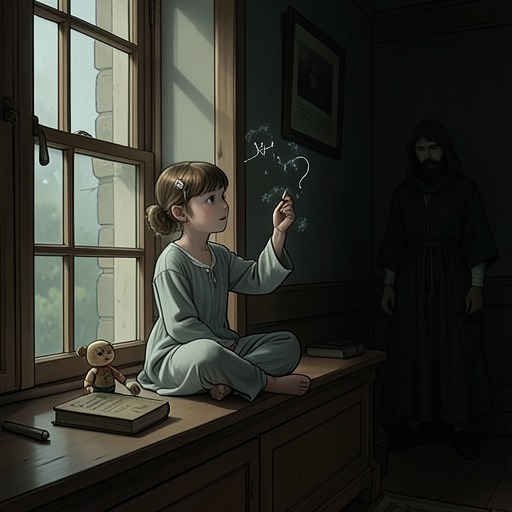
The song enters when Elias’s small voice reaches Anna through what the narration describes as the shell of her terror. Until then, she has been trying to break a wooden rack free to use as a weapon. She has laid Elias on rocky ground while working at the wood, and the creature is coming through the grass, only five metres away. The song does not arrive as a detached memory or a pause from the danger: Elias’s voice prompts it at the point when Anna needs to act.
The words she summons begin with a child walking in the woods and continue into images of roses on his cheek, sunshine in his eyes, and blueberries. Their bright, affectionate details stand against the immediate scene: Anna is exposed on the rocks, the creature is close, and she has seen black substance smeared around its mouth. The song’s remembered world is small and familiar; the threat around her is physical and present. That contrast gives the lyrics their force without changing what they can do. They do not make the danger disappear; they offer Anna something she can hold in thought while she faces it.
Singing as concentration
Anna cannot simply decide to feel calm. The narration says that she cannot think nice, but can sing in her mind. She fixes her attention on the song rather than on thoughts that might lead to anger and hatred, including thoughts of her father’s blood. In this scene, singing is not an expression of ease. It is an effortful direction of attention, maintained against fear and against the pull of what she has witnessed.
The effort is rendered as a separation between Anna and her body. She feels as though she is standing beside it, noticing its changes and seeing what it sees, while directing its brain to keep singing. This divided perspective makes the song more than a tune that happens to come back to her: it becomes the task by which she guides herself through the next actions. The narrative keeps her attention on that task rather than offering an explanation for her altered experience.
The lyrics themselves move from tenderness toward comic alarm. A passage about bushes shaking and a possible dog carries irony in the presence of the creature, and the irony makes Anna’s body tremble. Yet she goes on reciting. The juxtaposition does not turn the scene into a joke; instead, it makes the familiar song sound newly unsettling. Its ordinary playfulness persists while Anna is trying not to give way to terror.
The creature stops, then turns away
As Anna continues the song in her mind, the creature stops. Its legs freeze and its arms go limp, like a machine that has run out of fuel. The sequence places the creature’s sudden stillness directly after Anna’s concentration on the song, but it does not explain the connection or state that the lyrics themselves control it. The unexplained pause is decisive in the scene: it gives Anna time without making her safe.
She notices the black substance around the creature’s mouth and silently refuses to dwell on her father’s blood or on anything that could carry her toward hatred. Instead, she continues with the song. The creature turns and walks back toward the inlet, the jutting rocks, and her father’s body. Anna records this change without reflecting on it. The narration’s restrained attention to what she notices, rather than to an explanation of what the creature is doing, preserves the uncertainty of the moment even as its consequence becomes clear: the immediate route to Elias is no longer blocked.
A refrain sustained through escape
Anna waits until she reaches the end of the song before wrapping Elias in the blanket and walking down to the boat. When she sees the yellow light of her dropped cell phone, she picks it up and lays it on Elias’s stomach, but she dares not change songs for fear of breaking her concentration. The song’s continuation now accompanies small, necessary acts—recovering the phone, carrying Elias, and getting them into the boat. Its function is not simply to interrupt panic once; Anna keeps it going as the danger and her circumstances change.
Once they are afloat, she hears wet crunching sounds from the inlet and understands that the creature can swim. She keeps singing, although the sound and the knowledge renew her fear. She rows in the opposite direction, toward the open expanse of the Sea of Åland, because she cannot bear to move closer or perhaps see what is happening. After about fifty strokes, she lets the oars hang from the rowlocks, lies beside Elias, and stops singing as she stops fleeing. The song has carried her through the actions needed to get away; it has not erased the grief and fear that return when she can finally stop.
The episode gives “Mors lilla Olle” a sharply limited but consequential role. Its childhood images do not soften the approaching creature or resolve the loss surrounding Anna. Instead, their repetition provides a focus she can maintain when attention threatens to collapse into terror, anger, and the sight of blood. The song’s end matters as much as its use: Anna stops only after she has rowed far out with Elias, and then everything she had held at bay comes to her.